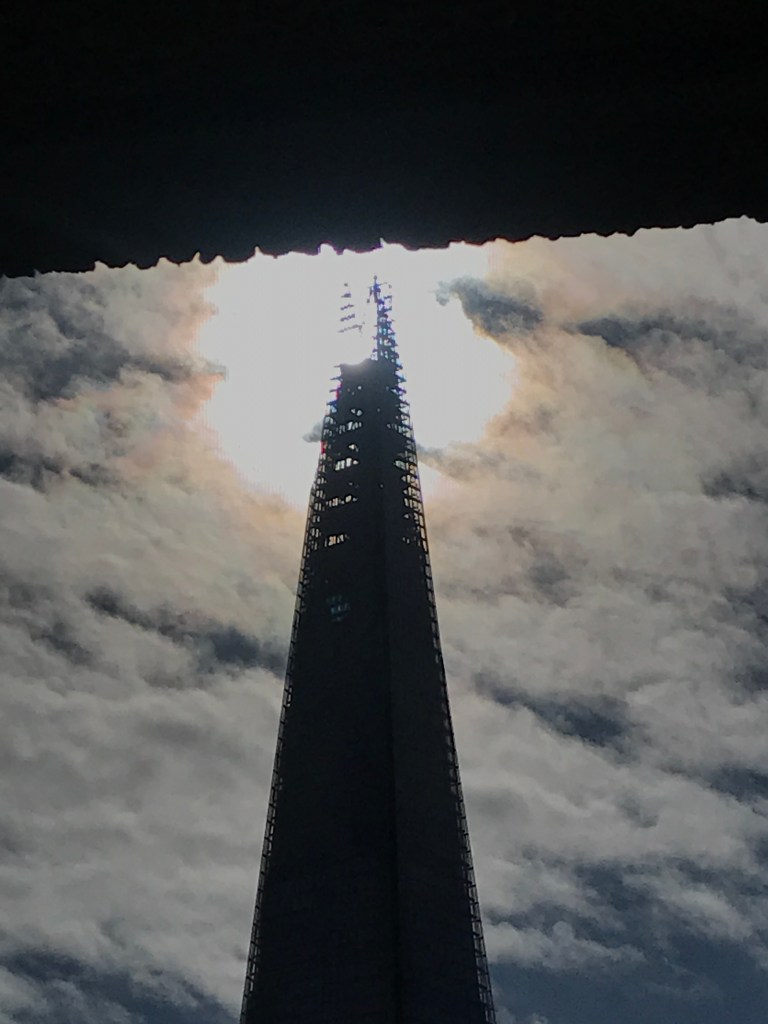
The next day though was a bit brighter, the cloud a bit higher and more transparent, and I arrived by the river to find the Sun much much lower than two and a half weeks previously. There’s no denying it changes quickly at this time of year.
So this was the first one on the north bank of the Thames. The north bank is riddled with tall buildings and twisting roads so this could be the last clear photo for a while. Even this was only possible because of an improbable and clearly unloved viewing platform high above the riverside path, and even then I was backed against the wall revealing the overhanging roof that crosses the top of the shot.
I’d been up here before to find nothing bar an empty vodka bottle, and this time it was rum. Nothing else. It’s a huge expanse, that whole red zigzag on Google Maps is just vacant flat terrace. Why is it not full of bars, seats, plants and skyline maps like the rest of the riverfront? Who owns it? Who maintains it and cleans up the bottles left by the few drinkers than know about it? Whoever, whatever, it’s the highest public bit of land in the area east of London Bridge, and without it I’d have been a good way further north. So I put the orange marker on the map vaguely norther too.
Curiosity piqued, I tried to find out who maintains this blank expanse. Looking at the map, it has Cubic London Bridge Office (Fireworks shop) and Sparkings Personnel (which doesn’t sound like a wise combination), along with Arachnys, Nova Financial Group and a couple of IFs. The building is called St Magnus House, so that’s a start.
St Magnus, like his over-the-river counterpart Olaf, was Norwegian. Unlike Olaf, he had a reputation for gentleness. He stayed on the ship and sang psalms rather than sack Anglesey, which can’t have gone down well with his fellow raiding Vikings, and he was eventually killed by a rival earl’s cook, while praying for the souls of his executioners. Not very much like Olaf at all, but there they stand commemorated facing each other across the river.
St Magnus House’s web page certainly lays claim to the terrace with a white line enclosing it:
https://stmagnushouse.com/location.php
But the website itself doesn’t mention it, perhaps as it’s public and not for sale. A regeneration proposal document on the City of London website does mention the terrace thus:
“The high-level terrace in front of St Magnus House is not clearly delineated as a public space and is underused, despite the fact that it affords some of the best views of the Thames.”
Indeed. It goes on to say:
“Possible improvements to increase footfall could include:
• Replacement of the existing staircase with a more open staircase leading directly from the Riverside Walk,
• Replacement of the high parapet walls with open railing/glass parapet, and
• Active frontage possibly including a café and roof garden to create an active space.”
Hard to argue with that. The full document is here:
http://democracy.cityoflondon.gov.uk/documents/s43377/Riverside%20Walk%20Enhancement%20Strategy.pdf
Since it’s dated November 2014, and the terrace is still home to naught but the odd empty spirit bottle, it might be safe to say it was ignored. Apparently such terracing and high walkways were part of a plan to literally elevate the citizens of the City post-war. Some still remain, footbridges cross roads and doubtless more such terraces are tucked away, but like the November 2014 proposals, it seems the grand ideas fell on deaf ears. Shame.
 Shard Analemma